
PACS Administration
What Is a PACS in Radiology? How It Works (2026 Guide)
Key takeaways
- A PACS (Picture Archiving and Communication System) is the technology that stores, retrieves, distributes, and displays medical images digitally.
- It replaces physical film and connects modalities, storage, a diagnostic viewer, and the network.
- PACS uses the DICOM standard for images and typically integrates with the RIS and the EHR via HL7/FHIR.
- Teleradiologists and PACS administrators work inside the PACS, so support does not require new clinical software.
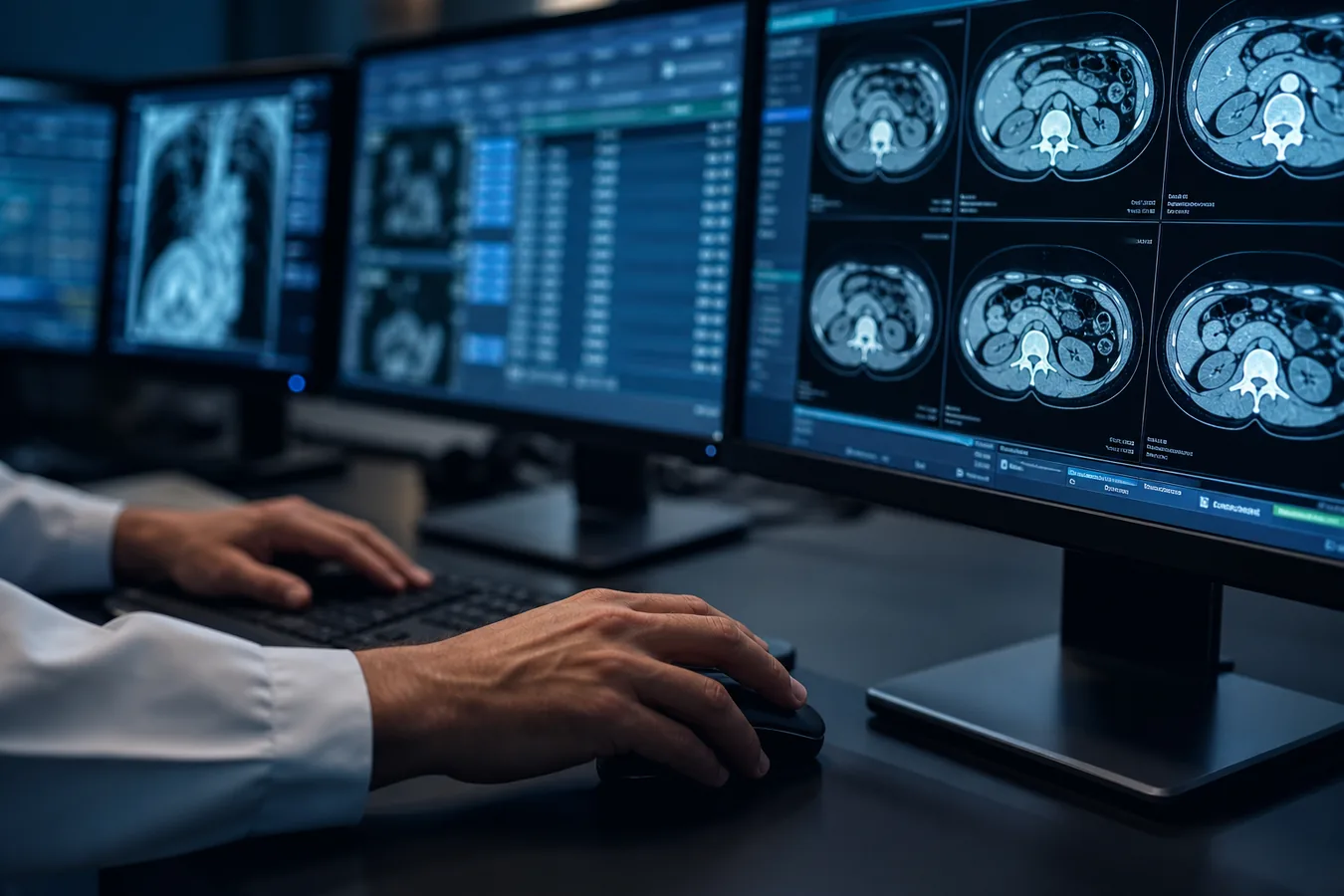
A PACS, or Picture Archiving and Communication System, is the technology radiology departments use to store, retrieve, distribute, and display medical images such as CT, MRI, X-ray, and ultrasound digitally. It replaced physical film, letting a radiologist pull up any study on a diagnostic workstation from anywhere with secure access.
In everyday terms, the PACS is the hub the entire imaging workflow revolves around: images go in from the scanners and come out on a radiologist's screen with tools to interpret them.
What are the main components of a PACS?
- Imaging modalities: the scanners (CT, MRI, X-ray, ultrasound) that acquire studies
- Secure network: moves images between modalities, storage, and viewers
- Storage / archive: short- and long-term retention of studies, increasingly cloud-based
- Diagnostic viewer / workstation: where radiologists interpret images with measurement and comparison tools
- Interfaces: connections to the RIS and EHR so orders, reports, and patient data stay in sync
How does a PACS work, step by step?
- 1A modality acquires the study and sends it to the PACS in the DICOM format.
- 2The PACS stores the study and links it to the correct patient and order.
- 3The study appears on the radiologist's worklist, prioritized by urgency.
- 4The radiologist opens it on a diagnostic viewer, compares priors, and interprets.
- 5The report is created and returned through integrated systems; images are archived.
What is the difference between PACS, RIS, and EHR?
| System | What it manages | Primary users |
|---|---|---|
| PACS | Medical images and their display/storage | Radiologists, techs |
| RIS | Radiology orders, scheduling, reporting workflow | Radiology staff, front desk |
| EHR | The patient's overall medical record | Clinicians across the organization |
The three systems talk to each other: DICOM carries images in the PACS, while HL7 and FHIR carry orders, results, and patient data between the RIS, EHR, and PACS.
Cloud PACS vs on-premise PACS: what is the difference?
An on-premise PACS runs on servers the facility owns and maintains. A cloud PACS runs on managed infrastructure accessed over a secure connection, which lowers hardware overhead and makes remote access, including teleradiology, simpler. Many facilities are migrating to cloud or hybrid PACS for scalability and easier disaster recovery, while keeping the same DICOM-based workflow.
Who administers a PACS?
A PACS administrator manages the operational side: user access, worklist configuration, routing rules, critical-results relay, and coordination between technologists, radiologists, and referring providers. This role can be handled in-house or remotely. Learn what the remote version covers in what a virtual PACS administrator does, and how it ties into reducing turnaround time.
About the author
RadAssistPro Clinical Operations
PACS Administration & Teleradiology Operations
The RadAssistPro clinical operations team supports U.S. radiology groups, imaging centers, and hospital networks with virtual PACS administration and preliminary teleradiology coverage that runs inside their existing PACS. Guidance below reflects real onboarding, relay, and turnaround-time workflows the team runs across supported facilities.