Teleradiology
After-Hours & Nighthawk Radiology Coverage: A Buyer's Guide
Key takeaways
- Nighthawk radiology is overnight and weekend radiology coverage delivered through teleradiology, usually as preliminary reads for emergency and urgent studies.
- It exists because staffing in-house radiologists for low-volume overnight shifts is expensive and hard to sustain.
- The main options are building an in-house night team, using a nighthawk teleradiology service, or a hybrid.
- Evaluate providers on turnaround-time commitments, state licensure coverage, credentialing, QA/discrepancy reporting, and whether they work inside your PACS.
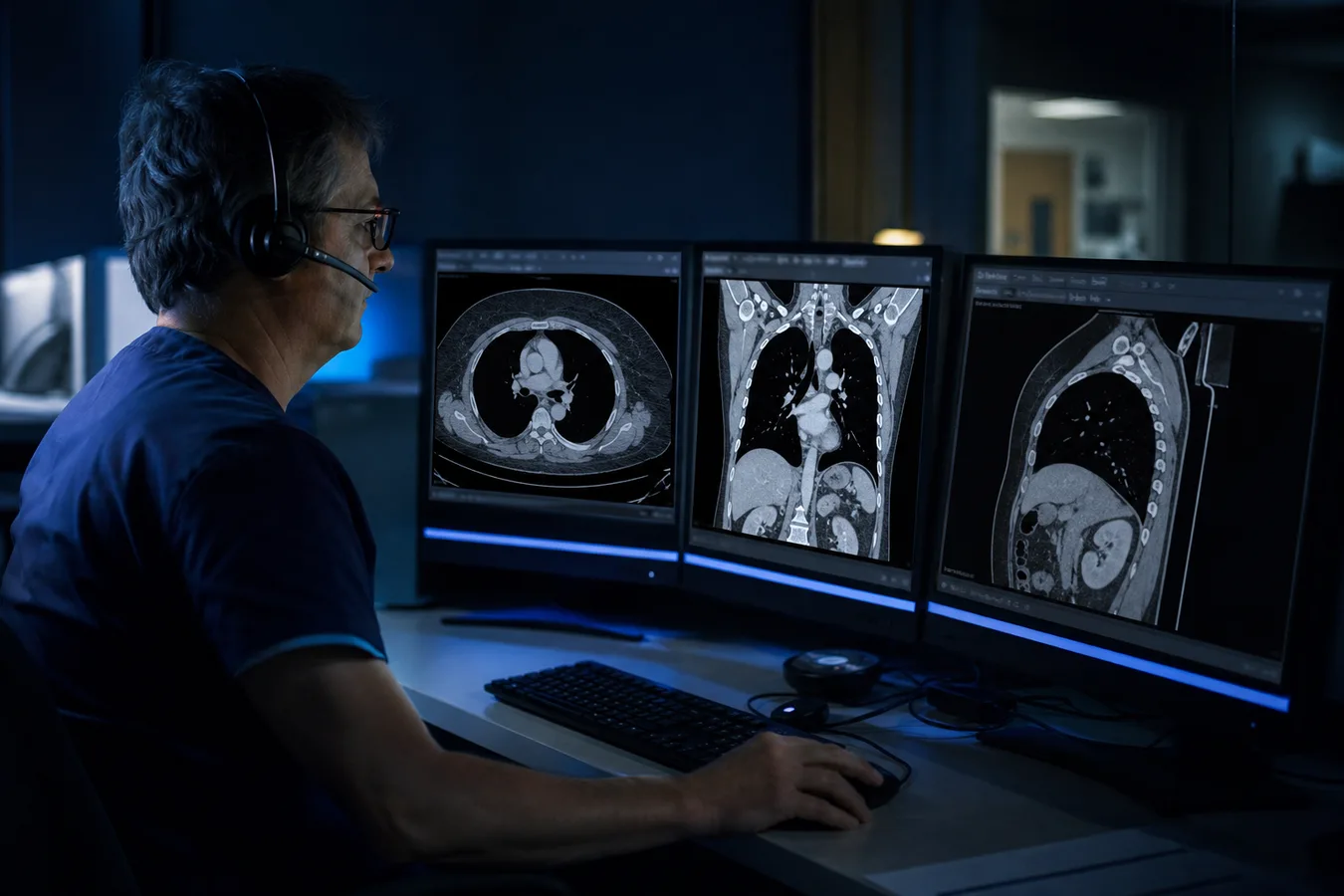
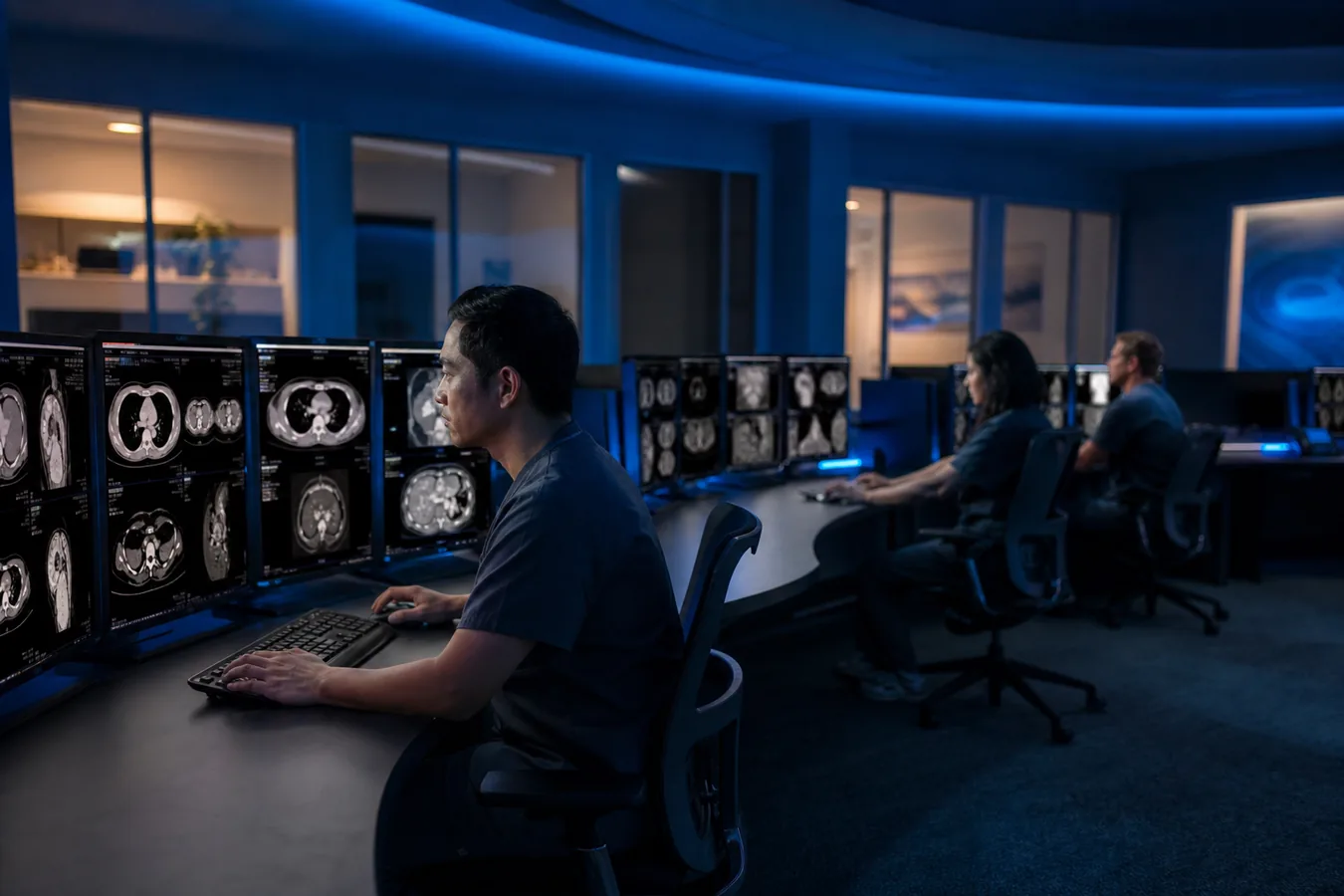
Nighthawk radiology is overnight and weekend radiology coverage delivered through teleradiology, typically as preliminary reads for emergency and urgent studies when a facility has no on-site radiologist. The term comes from the original model of remote radiologists covering U.S. nights from other time zones; today it broadly means reliable after-hours reads.
The reason nighthawk coverage exists is economic. Overnight imaging volume is often too low to justify a full in-house radiologist on every shift, but the studies that do come in, especially in the ER, are frequently time-critical.
What does nighthawk radiology cover?
- Overnight emergency and urgent care studies (CT, X-ray, ultrasound, and MRI as needed)
- Weekend and holiday coverage when in-house staff are off
- Preliminary reads to guide immediate treatment and disposition
- Immediate relay of critical findings per the facility's protocol
In-house vs outsourced after-hours coverage: which is better?
| Factor | In-house night team | Nighthawk teleradiology |
|---|---|---|
| Cost for low overnight volume | High (fixed salaries) | Lower (scales with volume) |
| 24/7/365 reliability | Hard to sustain | Built for it |
| Subspecialty access | Limited overnight | On demand |
| Speed to implement | Slow (hiring) | Weeks |
| Best for | High overnight volume | Variable or low overnight volume |
How do you choose a nighthawk radiology provider?
- 1Confirm turnaround-time commitments for preliminary reads and critical-results relay.
- 2Verify state licensure coverage for every state where your patients are located.
- 3Check credentialing capacity, including credentialing by proxy for hospitals.
- 4Review the QA process and ask for discrepancy-rate reporting.
- 5Confirm the service works inside your existing PACS with roles your IT controls.
- 6Ask about a U.S.-based account team and a documented escalation path.
How fast should overnight reads be?
For emergency studies, preliminary interpretations are commonly targeted in the range of minutes to under an hour, with critical findings relayed immediately. The exact target depends on your ER's needs and your internal policy, so make turnaround time a written commitment in the agreement rather than an informal expectation.
To understand how prelim and final reads fit together overnight, see preliminary vs final reads. For the economics, see the teleradiology cost and pricing guide.
About the author
RadAssistPro Clinical Operations
PACS Administration & Teleradiology Operations
The RadAssistPro clinical operations team supports U.S. radiology groups, imaging centers, and hospital networks with virtual PACS administration and preliminary teleradiology coverage that runs inside their existing PACS. Guidance below reflects real onboarding, relay, and turnaround-time workflows the team runs across supported facilities.